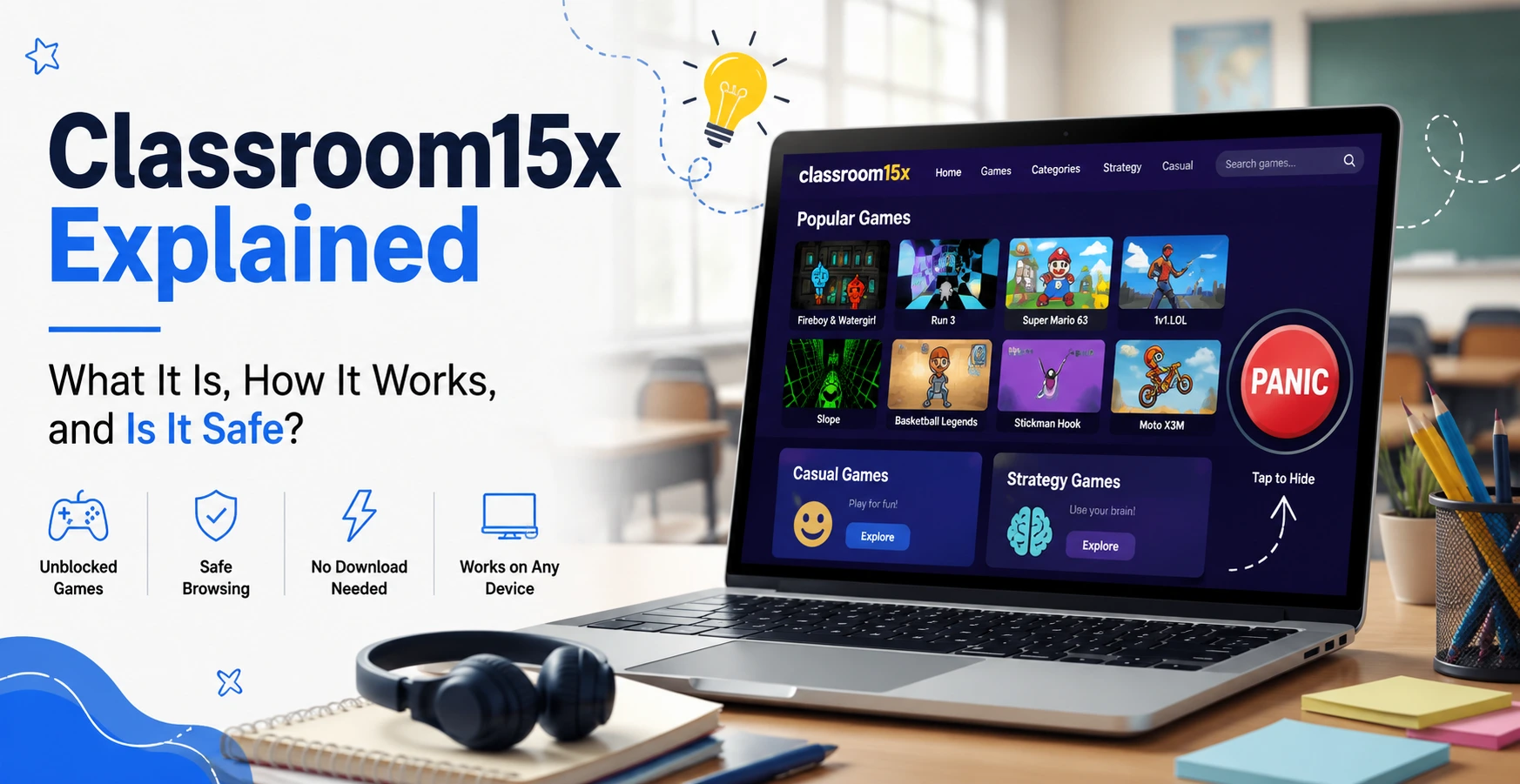
Classroom15x Explained: What It Is, How It Works, and Is It Safe?
If you have run into the word classroom15x online, you are probably a little confused, and that is fair. Some pages call it a fancy “smart classroom” model, while others call it a free games website. The short answer is that most people searching for it just want a browser-based games site they can open at school, and this guide clears up the mix-up once and for all.
By the end, you will know exactly what the platform is, how it works in a web browser, why students use it, what the “panic button” does, whether it is safe, and how teachers can use it the smart way. No hype, just clear answers.
What Classroom15x Actually Is
At its core, this is a website that lets you play small games right in your web browser. There is nothing to download and usually no account to create. You open the page, pick a game, and play. That simple setup is the whole appeal.
The games run through the browser, so they work on a school Chromebook, a home laptop, a tablet, or a phone. Because the site is often reachable on networks where bigger gaming sites are blocked, students call these “unblocked games.” They are the kind of quick action, puzzle, racing, and two-player titles you can enjoy in a short break.
Now, about the confusion. A handful of blogs describe the name as an “educational model” with smart boards, flexible seating, and AI-powered lessons. That version reads more like a marketing idea than a real product you can click on. The thing real people actually find and use is the games portal. Both meanings float around online, but they are not the same, and it helps to keep them separate.
Quick Facts at a Glance
Here is a simple summary so you can see the key points fast.
| Feature | What to Know |
|---|---|
| Type | Browser-based games website |
| Download needed? | No, games run in the browser |
| Account needed? | Usually no sign-up required |
| Works on | Chromebook, laptop, tablet, phone |
| Popular for | Unblocked games at school |
| Game types | Action, puzzle, racing, two-player |
| Handy feature | “Panic button” to hide the screen fast |
| Cost | Free to play |
The table makes the big takeaway clear: this is a free, no-install, no-login site built for quick play on almost any device. The “unblocked” label is why it spreads through schools, and the panic button is the feature that tells you it was designed with classroom settings in mind. Keep those points in your head and the rest of the topic makes sense.
How It Works in a Web Browser
The platform relies on lightweight web games, often built with common web technology like HTML5. Because everything loads inside the browser tab, your device does not need special software or a powerful graphics card. That is why an old school laptop can still run these titles smoothly.
Here is the basic flow when you use it:
- Open the site in any modern browser like Chrome, Edge, or Safari.
- Browse the library and pick a game by its thumbnail or title.
- The game loads in the same tab and starts within seconds.
- Play with your keyboard, mouse, or touch screen.
- Close the tab when you are done. Nothing stays installed.
Some versions group games into modes, such as a casual set for pure fun and a strategy set for games that make you think. This is a small touch, but it helps you find the type of game you are in the mood for without scrolling forever. In practice, this is what makes classroom15x feel quick and beginner-friendly.
Why Students and Teachers Use It
The main reason is obvious: it is an easy way to take a short mental break. A five-minute puzzle between two hard lessons can reset your focus, and plenty of students swear by it. But there is more to it than just killing time.
- Quick stress relief during a busy school day
- Puzzle and strategy games that build problem-solving skills
- Two-player games that let friends team up or compete
- Better hand-eye coordination from fast action titles
- No setup, so it works even on locked-down school devices
Teachers sometimes use short game breaks as a reward after finishing work, or as a quick warm-up at the start of class. When a game ties into a lesson, like a puzzle that uses logic or a math idea, it can make an abstract topic feel more real. The trick is using it on purpose, not letting it take over the period.
The “Panic Button” and Classroom Use
One feature that shows this site was made with school in mind is the so-called panic button. With one tap, it can switch the screen to something that looks like normal schoolwork. Students use it when a teacher walks by, which is honestly why the tool gets talked about so much.
It is worth being straight about this. A panic button exists to hide gameplay, and that tells you these games are often played when they are not supposed to be. There is nothing wrong with a game break, but sneaking one during a lesson can hurt your grades and your trust with a teacher. The smarter move is to play during free time, lunch, or an approved break.
Is Classroom15x Safe to Use?
For the most part, playing simple browser games carries low risk, especially since you usually do not create an account or share personal details. That no-login setup is actually a privacy plus, because you are not handing over your name or email.
Still, a few real cautions apply, and being aware of them keeps you out of trouble.
- Copycat sites. Because the name is popular, look-alike pages pop up. Some show heavy ads, misleading “download” buttons, or sketchy pop-ups. Stick to the version you trust and close anything that pushes you to install a file.
- Ads and redirects. Free game sites make money through ads. Never click a pop-up that claims you won a prize or that your device has a virus. Those are classic tricks.
- School rules. Just because a site loads does not mean it is allowed. Playing against school policy can get your device flagged. Check what your school permits.
- Personal data. No real game here needs your password, phone number, or payment info. If a page asks for that, leave.
Follow those four habits and the experience stays clean and simple. The same care applies to any download-style page, like the safety tips in our guide to spotting risky game download sites.
The “Educational Model” Interpretation
Since some articles frame the name as a full teaching system, it is worth addressing so you are not misled. In that version, the idea describes a modern classroom with movable desks, interactive whiteboards, student tablets, quick check-in quizzes, and software that adapts to each learner. Supporters point to research suggesting students in tech-rich, flexible rooms can score higher and stay more engaged, an idea explored in educational technology research.
Those ideas are real trends in education, and flexible learning spaces genuinely help many students. But that concept is bigger than any single website, and it is not something you “log into.” When you see the name used that way, treat it as a description of a teaching style, not the games site you can open in a tab. Keeping the two apart saves a lot of confusion.
Common Mistakes to Avoid
- Trusting the first search result without checking for a safe, ad-light version.
- Playing during a lesson and relying on the panic button instead of free time.
- Clicking fake “download” or “you won” pop-ups on copycat pages.
- Entering any personal information, which real browser games never require.
- Assuming the “smart classroom” articles describe the same thing as the games site.
Avoiding these five slip-ups covers almost every problem people run into with this topic.
Practical Tips to Get the Most Out of It
If you are a student, treat game breaks like a snack, not a meal. A short round to recharge is great; a whole class period is not. Pick puzzle or strategy titles when you want your brain to stay sharp, and save the fast action games for true downtime.
If you are a teacher, start small. Try one five to ten minute game as a warm-up or reward, gather quick feedback, and tie the game to a learning goal when you can. Set a clear time limit so play does not spill into lesson time. Used this way, a quick game can lift the mood of a room without costing you the lesson.
Frequently Asked Questions
Is classroom15x free to use? Yes. The games are free and play right in your browser, with no purchase and usually no account needed.
Do I need to download anything? No. Everything runs inside the browser tab, which is why it works on Chromebooks and low-power laptops.
Why is it called an “unblocked” games site? Because it often loads on school or work networks where bigger gaming sites are blocked, letting students play during breaks.
What is the panic button for? It quickly hides the game and shows a school-friendly screen. It is popular, but the honest advice is to play during allowed free time instead.
Is it safe for kids? The games themselves are usually low-risk, and no sign-up means less data sharing. The main dangers are ads, pop-ups, and copycat sites, so stick to a trusted version.
Is this the same as the “smart classroom” model I read about? No. Some articles use the name for a modern teaching setup with flexible desks and AI tools. That is a teaching idea, not the browser games site.
Can teachers actually use it in class? Yes, in small doses. Short, purposeful game breaks tied to a lesson goal can boost focus and engagement when time limits are set.
Final Thoughts
Once you cut through the noise, classroom15x is simply a free, browser-based games site that students love because it needs no download, no login, and runs on almost any device. The panic button and the “unblocked” label are what make it spread through schools, while a separate set of articles borrow the name for a broader smart-classroom teaching idea.
Use it the smart way: play during real breaks, avoid shady copycat pages and pop-ups, never share personal details, and, if you are teaching, keep game time short and tied to a goal. Handle it like that and you get the fun and the focus boost without any of the headaches.