Renvoit com: What It Is, How It Works, and Is It Safe to Use?
If you have come across renvoit com and want to know what it does before you upload anything, this guide gives you a clear, honest answer. In plain terms, renvoit com is a free browser-based file-transfer tool that lets you send files through a shareable link, and here you will learn how it works, whether it is safe, and when you should use something else instead.
You will get a straight look at the good and the not-so-good: how the service handles your files, the privacy and transparency concerns worth knowing, who it suits, and safer alternatives for anything important. No hype, just the facts you need before you trust it with your data.
What Renvoit com Actually Is
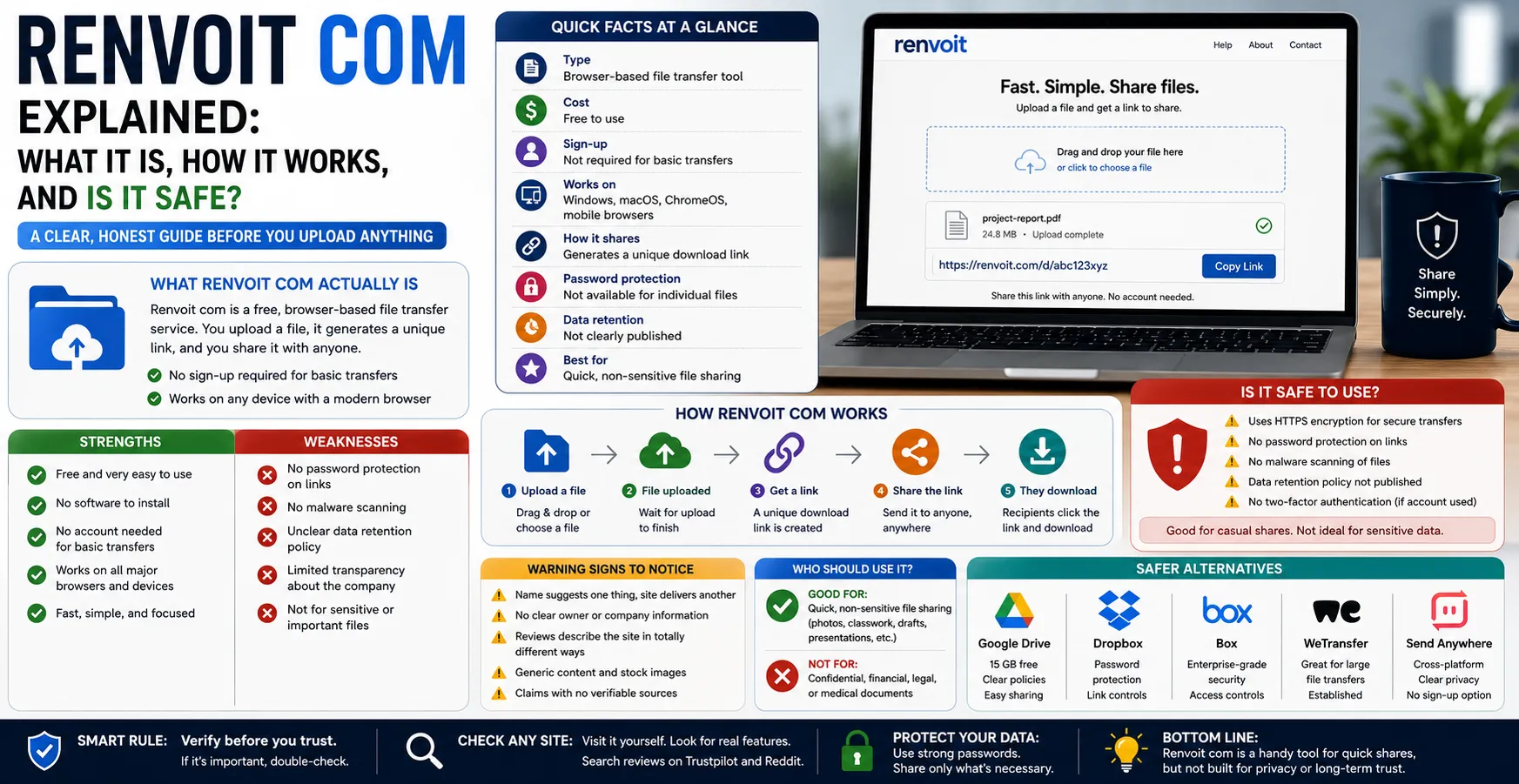
At its core, renvoit com is an online file-sharing service that works right in your web browser. You open the site, upload a file, and it gives you a unique link. You send that link to someone, and they download the file, often without needing to create an account. It is the same basic idea as WeTransfer or Dropbox Transfer.
There is nothing to install. It works on Windows, macOS, and ChromeOS, and it runs in common browsers like Chrome, Firefox, Safari, and Edge. Mobile browsers work too, though very large uploads tend to go more smoothly on a desktop connection.
The whole point of the tool is speed and simplicity. It strips away extra features and focuses on one job: moving a file from you to someone else quickly. That makes it handy for a fast, casual share, but it also means it lacks many of the controls that bigger services offer.
Quick Facts at a Glance
Here is a fast summary so you can size it up in seconds.
| Detail | What to Know |
|---|---|
| Type | Browser-based file transfer tool |
| Cost | Free to use |
| Sign-up | Not required for basic transfers |
| Works on | Windows, macOS, ChromeOS, mobile browsers |
| How it shares | Generates a unique download link |
| Password protection | Not available for individual files |
| Data retention | Not clearly published |
| Best for | Quick, non-sensitive file sharing |
The table shows the trade-off in one glance. The service is genuinely easy and free, which is its main strength. The weak spots are the ones that matter for privacy: no password protection on links, and no clear policy on how long your files are kept. Keep those two points in mind, because they shape everything below.
How Renvoit com Works
Using the tool is about as simple as file sharing gets. The process usually looks like this:
- Open the website in any modern browser.
- Drag a file into the upload box, or pick one manually.
- Wait for the upload to finish, which depends on your file size and internet speed.
- Copy the unique link the site creates for your file.
- Send that link to whoever needs the file.
Anyone who has the link can download the file, with no account needed on their end. That is what makes it fast, but it is also the core of its biggest weakness. A link is the only lock on the door, so whoever holds it gets in.
Is Renvoit com Safe to Use?
For everyday, low-stakes sharing, the basic safety of renvoit com is reasonable. The site uses HTTPS encryption, which protects your file while it travels between your device and the server. There are also no widely reported breaches tied to the service so far.
That said, there are real limits you should understand before trusting it with anything private:
- No password protection. Individual transfers cannot be locked, so anyone with the link can open the file.
- No malware scanning. The service does not check uploaded files for viruses, so downloads deserve the same caution as email attachments.
- Unclear retention. There is no clear published policy on how long files stay on the servers, and links can stop working without notice.
- No two-factor login. Account security, where accounts exist, rests on your password alone.
None of this makes the tool a scam. It simply means it is built for convenience, not for protecting sensitive material.
The Transparency Concerns Worth Knowing
Here is the part many quick reviews skip. Beyond the technical limits, renvoit com is thin on the kind of transparency that builds trust. There is little public information about the company behind it, no clear physical address, and only a generic contact email.
The terms and privacy policy are also vague about important details, like exactly how your data is handled, how long files are kept, and whether anything is shared with third parties. For a casual one-off transfer, that may not bother you. For anything you would be upset to lose or expose, that uncertainty is a real reason to pause.
A simple rule helps here: the less you know about who runs a service and what they do with your files, the less sensitive the data you should trust it with. We use the same yardstick in our honest privacy tool reviews.
Strengths and Weaknesses
Every tool has trade-offs, so here is a balanced view to help you decide.
What it does well:
- Free and quick, with no software to install.
- No account needed for a basic transfer.
- Works across major browsers and operating systems.
- Clean, simple interface focused on one task.
Where it falls short:
- No password protection or access controls on links.
- No published data-retention or clear privacy policy.
- No malware scanning on uploaded files.
- Little transparency about the company behind it.
Who Should Use It, and Who Should Not
The renvoit com tool fits some situations well and is a poor match for others. Knowing the difference saves you trouble.
It is fine for quick, non-sensitive sharing: a photo to a friend, a class assignment, a design draft, or any file you would not mind a stranger seeing. For those casual moments, its speed and simplicity are genuinely convenient.
It is not the right choice for confidential or important material, such as financial records, legal documents, medical files, or anything tied to your business. For those, a service with password protection, clear policies, and a known company behind it is worth the small extra effort.
Safer Alternatives for Important Files
If you need more control or you are sharing something sensitive, several established services offer stronger protection with clear policies.
- Google Drive gives you 15 GB free, keeps files until you delete them, and integrates well across devices.
- Dropbox and Box offer sharing with passwords, expiry dates, and access controls.
- WeTransfer handles large files with a more established track record.
- Send Anywhere provides quick transfers with clearer privacy terms.
A quick tip: for anything truly private, encrypt the file yourself before uploading, or use a service that offers password-protected links. That way a stray link alone is not enough to expose your data.
Common Mistakes to Avoid
- Sending sensitive documents through a link that has no password.
- Assuming files stay available, when links can expire without warning.
- Opening downloads without scanning them for malware first.
- Sharing a link in a public place where others can copy it.
- Relying on the service as backup storage instead of a quick transfer.
Avoiding these five mistakes covers almost every real risk people run into with free transfer tools.
Frequently Asked Questions
What is renvoit com? It is a free, browser-based file-transfer service that lets you upload a file and share it through a unique download link, usually without creating an account.
Is it safe to use? For casual, non-sensitive files, the basic HTTPS security is fine. The weak points are no password protection, no malware scanning, and an unclear data policy, so avoid it for private material.
Do I need an account? No. Basic transfers work without registration. Accounts may add some management features, but they are not required to send a file.
How long do files stay online? The service does not clearly publish a retention period, and links can stop working without notice. Do not rely on it to store files long term.
Can I password-protect a transfer? No. Individual links cannot be locked, so anyone who receives the link can download the file. Use another service if you need access control.
Is it good for business use? Not really. It lacks the security features, clear policies, and transparency that business file sharing needs. A managed service is a better fit.
What is a safer alternative? Google Drive, Dropbox, Box, or WeTransfer offer clearer policies and stronger controls like passwords and expiry dates.
Final Thoughts
Stripped of the noise, renvoit com is a free, no-frills file-transfer tool that does one thing well: moving a file to someone through a quick shareable link. It is genuinely handy for casual, everyday sharing where privacy is not a concern, and its simple, install-free design is easy for anyone to use.
The honest catch is the lack of password protection, unclear data handling, and limited transparency about who runs it. For low-stakes files, that is a fair trade for speed. For anything private or important, lean on an established service with clear policies and real access controls, and you get convenience without putting your data at risk.